
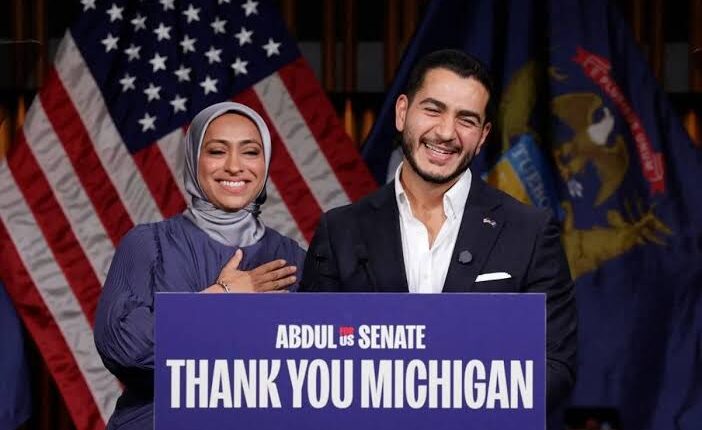

Democrat Abdul El-Sayed has made history by becoming the first Muslim elected to the United States Senate after winning Michigan’s open Senate seat in the November 3 midterm elections.
El-Sayed, 42, defeated Republican candidate Mike Rogers, a former congressman and FBI agent, in a closely contested race, according to media projections on Tuesday.
His victory preserves a crucial Democratic seat following the decision of incumbent Senator Gary Peters, also a Democrat, to retire. It also marks a major breakthrough for the progressive wing of the Democratic Party.
El-Sayed’s election is particularly significant because, although Muslims have previously served in the US House of Representatives, no Muslim had been elected to the Senate before his victory.
The Michigan race attracted national attention, with Republicans hoping to capture the seat as part of their efforts to maintain control of Congress.
El-Sayed campaigned on an economic platform centred on reducing the cost of living for working families, expanding access to healthcare and limiting the influence of wealthy corporations in politics.
A major component of his programme was Medicare for All, a progressive proposal that seeks to establish a government-funded universal healthcare system for Americans.
His opponent, Rogers, enjoyed strong backing from President Donald Trump and national Republican figures.
He sought to portray El-Sayed as a radical candidate sympathetic to Islamic extremism, alleging links to the Muslim Brotherhood.
El-Sayed denied the allegations, which were not supported by publicly established evidence. Democrats criticised the attacks, describing them as attempts to exploit Islamophobic stereotypes against the candidate.
Rogers also sought to appeal to Jewish voters who had expressed concerns about El-Sayed’s opposition to US military assistance to Israel and his description of Israel’s actions in Gaza as genocide.
However, the Republican struggled to overcome concerns among voters about the economy and dissatisfaction with Trump’s performance.
During the final weeks of the campaign, Rogers also distanced himself from the president on some foreign policy and trade issues, including the war in Iran and the trade dispute with Canada. He argued that ending both disputes was necessary to reduce costs for American businesses and consumers.
The result represents a significant setback for Republicans, who entered the election with a 53-47 majority in the Senate. Democrats needed a net gain of four seats to take control of the chamber.
Before entering electoral politics, El-Sayed built his career in public health and public service.
A physician and epidemiologist, he previously served as executive director of the Detroit Health Department, where he worked on public health programmes and efforts to address health inequalities.
He came into national political prominence in 2018 when he contested the Michigan governorship as a progressive Democrat but lost the party’s primary to Gretchen Whitmer, who went on to win the general election.
His 2018 campaign attracted attention for its emphasis on universal healthcare, economic equality and political reform.
El-Sayed’s latest victory takes that political ambition to the national stage, giving him a place in the upper chamber of the US Congress.
Growing Muslim Representation in American Politics
El-Sayed’s election marks a historic moment for Muslim representation in the United States, where Muslims constitute a minority of the population but have become increasingly visible in electoral politics.
Muslim Americans have previously won seats in the House of Representatives, including Democrats Ilhan Omar of Minnesota and Rashida Tlaib of Michigan, both of whom made history in 2018 as the first Muslim women elected to Congress.
Keith Ellison, also a Democrat from Minnesota, became the first Muslim elected to Congress in 2006.
Unlike members of the House, senators represent entire states and serve six-year terms, making El-Sayed’s victory a significant expansion of Muslim representation at the federal level.
His election is also likely to energise progressive Democrats seeking to reshape the party’s positions on healthcare, economic inequality, corporate influence and US foreign policy.