
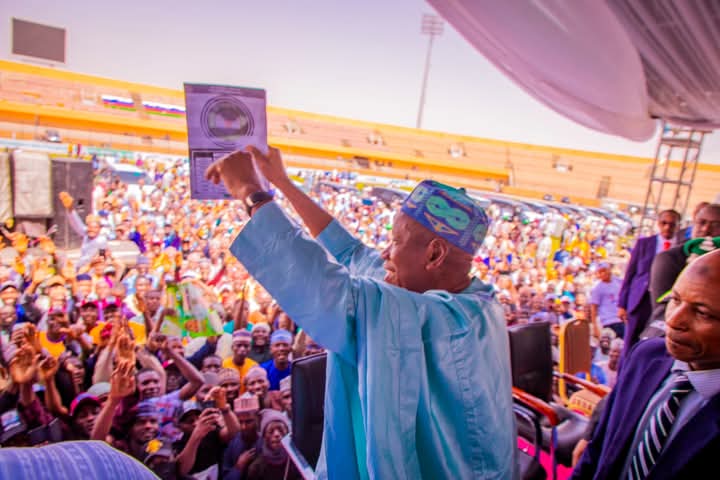

When Comrade Muhammad Garba, former Chief of Staff to the immediate past National Chairman of the All Progressives Congress (APC), Dr. Abdullahi Umar Ganduje, appeared on Dan’uwa Rano TV for a special interview last week, the discussion quickly moved beyond politics to legacy, the kind of legacy that continues to shape northern politics and Nigeria’s ruling party ahead of 2027.
In the interview, monitored by The Historica Nigeria, Garba’s tone reflected confidence, conviction, and loyalty. He spoke about a party finding its rhythm again after months of internal restructuring and a leader, Ganduje, whose political touch still resonates across Kano and the North.
According to him, Nigeria under President Bola Ahmed Tinubu is gradually stabilizing. Economic reforms are beginning to show impact, the naira is appreciating, and food prices are easing all signals, he said, that the Renewed Hope Agenda is taking shape. “People are beginning to benefit from the reforms introduced by the Tinubu administration,” he remarked. “This shows that the government’s efforts are yielding results.”
Related:
North’s Loyalty to Tinubu Will Echo Loudly in 2027 – Ganduje Loyalist
But Garba’s reflections were not only about economic recovery. They painted a portrait of Ganduje’s quiet but enduring influence, the strategist who, despite stepping down as APC National Chairman, remains a stabilizing force in the party’s northern structure.
A Leader Beyond Titles
Garba was emphatic that Dr. Ganduje’s resignation had nothing to do with political friction. “It was a personal decision,” he said, “after ensuring that all frameworks were in place for the APC to thrive.”
He described how Ganduje’s leadership reconciled aggrieved factions, restored unity, and expanded the party’s reach across Nigeria. “Even after leaving office, Ganduje continues to attend to party matters late into the night. His dedication to public service is rare,” Garba added.
Indeed, Ganduje’s political career has always been defined by persistence and bridge-building traits that became evident during his tenure as governor of Kano State, where he balanced governance with grassroots mobilization. His administrative style, though sometimes controversial, remains admired by many as pragmatic and people-focused.
Defending Legacy Amid Political Tensions
For Garba, the renewed campaign of allegations against Ganduje particularly the claim that his family has stakes in the Dala Inland Dry Port represents the darker side of Kano’s hyper-politicized environment.
“The records are clear,” Garba asserted. “The Corporate Affairs Commission shows no link between the Ganduje family and the company. These are baseless allegations meant to mislead the public.”
Read Also:
Dala Inland Dry Port Dismisses Reports Linking Ganduje’s Family to Ownership
The Dala Inland Dry Port management had earlier issued a similar statement, dismissing the reports as “false, misleading, and politically motivated,” confirming that neither Ganduje’s family nor the Kano State Government held shares in the project.
Garba framed these allegations as part of a wider attempt to undermine Ganduje’s credibility, a pattern not unfamiliar in Nigeria’s political landscape, where rivals often resort to propaganda when facts fail.
A Political Structure Built To Last
Since leaving the national chairmanship of the APC, Ganduje has maintained regular consultations with President Tinubu and other senior figures. Garba noted that these engagements reflect continuity, not conflict. “The two leaders are still consulting on national and political development,” he said.
For Garba and many within Kano APC, Ganduje remains the rallying point. “Everybody knows Dr. Ganduje is the top leader in Kano, followed by the Deputy Senate President, Barau Jibrin,” he clarified. “Leadership is based on experience and hierarchy, and Ganduje stands as our most senior APC leader in the state.”
Analysts say this hierarchy could play a decisive role in the 2027 elections. The Ganduje political family, built over decades, still commands loyalty across local government structures, from ward coordinators to national strategists.
Kano’s Political Mirror
Garba’s interview also offered a rare glimpse into the internal thinking of Kano’s APC. The emphasis, he said, is not on rivalry but on consolidation. “Our focus is to reclaim Kano in 2027 and deliver a second mandate for President Tinubu,” he affirmed.
He was, however, critical of the current NNPP-led administration in the state, describing it as “plagued by scandal and internal contradictions.” Garba alleged that cases of mismanagement and fraud are emerging within the government, warning that “the same energy used to smear others should now be used to clean their own house.”
Still, his tone was not entirely combative. Garba urged the NNPP government to build upon Ganduje’s projects instead of discarding them. “If they continue with Ganduje’s development plans and add their own ideas, Kano will move forward,” he advised.
Beyond Kano: The Northern Equation
Garba’s defense of Ganduje also touched on the broader northern political calculus. For him, Tinubu’s bond with the North remains intact. “The North will stand by President Tinubu in 2027,” he insisted, echoing sentiments shared by several northern APC stalwarts in recent months.
He cited Ganduje’s bridge-building politics as one of the key reasons for that continuity. As a former governor, national chairman, and grassroots mobilizer, Ganduje has not only influenced APC’s internal dynamics but also served as one of the strongest political links between the North and the presidency.
The Legacy Continues
For many observers, Ganduje’s enduring relevance lies in his consistency, a trait that has kept him politically visible even out of office. His former aides, including Garba, describe him as “a man who never stops working.”
In the final moments of the interview, Garba’s voice carried a note of reflection. “We should fear God in this political journey,” he said. “Dr. Ganduje has done his part for Kano and the North. Politics should not destroy what has been built.”
It was a statement both political and moral, one that summed up the struggle of many Nigerian politicians seeking legacy beyond position.
And for Ganduje, whose name still commands loyalty, controversy, and admiration in equal measure, the story continues not just in offices or rallies, but in the lasting political structures he helped to shape.