
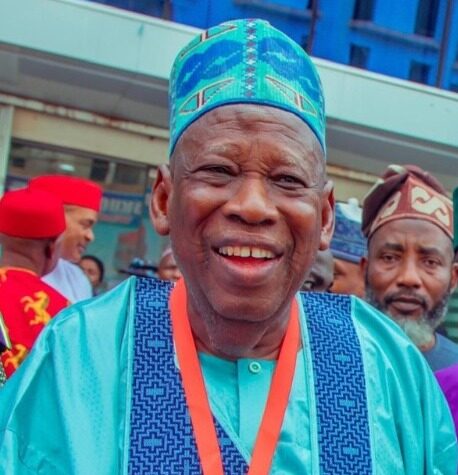
An ardent loyalist of the immediate past All Progressives Congress (APC) National Chairman, Dr. Abdullahi Umar Ganduje, Umar Idris Shuaibu, has expressed confidence that the North, particularly Kano State, will repay President Bola Ahmed Tinubu’s goodwill with overwhelming support in the 2027 general elections.
Speaking in an exclusive interview with newsmen in Kano, Umar Idris explained that the President’s long-standing alliance with northern leaders, combined with Ganduje’s humility and reconciliatory politics, has strengthened the APC’s unity and consolidated its presence across the North-West and the North at large.
He added that Ganduje’s political influence and people-oriented leadership remain the backbone of the party’s stability and growing popularity in Kano and beyond, even though he is no longer in office as national chairman.
“Dr. Ganduje’s calm temperament and people-focused politics have made him a different kind of leader,” Umar said. “He is patient, accommodating, and always ready to forgive. That is why the APC continues to grow stronger under his influence.”
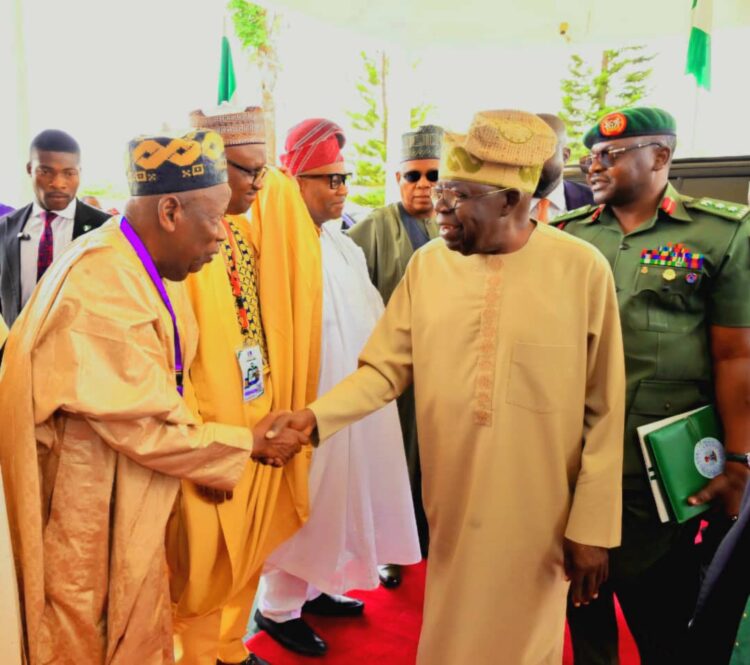


He recalled that when Ganduje assumed office as APC National Chairman in August 2023, the party was facing deep internal crises. However, within a short period, Umar noted, Ganduje reconciled aggrieved members, rebuilt trust, and restored unity among stakeholders.
“Immediately he became the national chairman, there were divisions within the APC, but he brought everyone together,” he explained. “He reached out to those who were offended and worked hard to ensure that everyone had a sense of belonging. That’s the mark of true leadership.”
Related:
Ganduje’s Vision Still Standing Tall: The Truth Behind Dala Inland Dry Port
Umar emphasized that even with the APC out of power in Kano for over two years, the party’s structure has remained strong because of Ganduje’s sustained engagement with grassroots supporters and continuous investment in the welfare of loyalists.
“Even without holding power in the state, the APC remains strong because of Dr. Ganduje’s political structure and his ability to carry everyone along,” he said.
He further highlighted the efforts of Ganduje’s son, Abba Ganduje, who has launched several empowerment initiatives to uplift party members and reinforce the APC’s base across the state. According to Shuaibu, the younger Ganduje recently introduced three schemes, including food distribution and self-reliance support programmes that have benefited hundreds of loyalists.
In addition, Umar commended other prominent APC figures, such as the Minister of State for FCT, Dr. Mariya Mahmoud Bunkure; Chairman of the House of Representatives Committee on Appropriation, Hon. Abubakar Kabir Abubakar, popularly known as ‘Abba Bichi’; and Hon. Baffa Babba Dan’agundi, for initiating similar efforts to support grassroots members, noting that these programmes continue to attract more supporters to the party.
Read Also:
Ganduje After the APC Chairmanship: Relevance, Influence, and the Road to 2027
“Because of these programmes, people are regaining confidence in the APC,” he said. “It’s no longer about promises — it’s about real empowerment and opportunity.”
Moreover, he described the establishment of the Progressive Institute (TPI) by Dr. Ganduje as one of the most significant contributions to the party, explaining that the institute has become a think tank for research, training, and policy formulation within the APC and Nigeria at large.
“The Progressive Institute is a major legacy that will outlive Ganduje’s tenure,” Shuaibu remarked. “It is through this institute that many of the party’s developmental ideas and national policies are being shaped. It shows how Ganduje is thinking beyond politics — he’s building intellectual capacity for the future.”
According to Umar Idris Shuaibu, Dr. Ganduje’s foresight and reconciliatory leadership have not only strengthened the APC in Kano but also enhanced its prospects ahead of the 2027 general elections.
“With Ganduje as national chairman, APC members in Kano and across Nigeria became more united than ever,” he declared. “His leadership is a blessing to the party. We are fully ready to support whoever he chooses as our governorship candidate in 2027.”
He also praised President Tinubu for his long-standing relationship with northern political leaders, stressing that the North would reciprocate the goodwill with massive support at the polls.
“President Tinubu has always stood by the North, and the North will surely stand by him when the time comes,” Shuaibu said. “The goodwill he enjoys across the region will speak loud in 2027.”
Shuaibu reiterated that Ganduje’s leadership style — centered on humility, dialogue, and inclusiveness — remains the driving force behind the APC’s growing strength and stability across the country.
“Ganduje’s legacy will not just be about winning elections,” he added. “It will be about building people, strengthening the party, and leaving behind structures that will keep the APC strong for many years to come.”
Political observers note that Ganduje’s continued relevance — even out of office — underscores the power of loyalty, grassroots connection, and bridge-building in Nigeria’s evolving political landscape.
During his eight-year tenure as governor of Kano State, Dr. Ganduje built a resilient political apparatus that combined infrastructural development, targeted empowerment schemes, and a wide network of ward- and council-level mobilisers.
Analysts say his investments in local outreach and cadre-building created a loyal base capable of sustaining political organisation even when the APC was out of state power.
After his governorship, that structure has been maintained through trusted lieutenants, family-led outreach efforts, and the Progressive Policy Institute, ensuring a steady line of communication between grassroots activists and state-level strategists.
Abdulmalik Hotoro, a Kano-based supporter in Tarauni Local Government Area, explained how Ganduje’s model operates and what it could mean for 2027. He said the network is not merely a personality cult but a multilayered organisation:
“At the base are ward mobilisers and community leaders whose livelihoods are tied to the party’s local programmes; above them sit local council coordinators and trusted party executives who translate policy promises into visible outreach.
“The TPI supplies the intellectual content — training, policy messaging, and candidate grooming — while empowerment initiatives provide the immediate material link to voters. This combination creates loyalty that is both emotional and transactional.”
He added that Ganduje’s influence extends beyond Kano into neighbouring North-West states where similar patronage and mobilisation patterns have taken root, noting that those links can be activated quickly during an election cycle. Yet he also cautioned that organisational strength alone cannot guarantee results.
“Economic frustrations, security concerns, and youth disaffection can blunt the impact of even the most disciplined machine. Opposition parties will try to tap local grievances, and emerging political movements could appeal to younger voters who are less tied to traditional mobilisers. Reliance on patronage carries reputational risks; if empowerment programmes are perceived as selective or opaque, they could feed narratives of exclusion rather than inclusion.”
Hotoro concluded with a strategic observation for President Tinubu: “What Ganduje offers is organisational reach and dispute mediation within the North — both crucial in a tight national contest. But Tinubu’s campaign must also address macroeconomic and security issues that voters care about.
“The northern machinery can amplify support, but it cannot substitute for credible policy wins. In 2027, the equation will be mobilisation plus message plus measurable results. Ganduje’s network satisfies the first; the administration must deliver on the other two.”
Finally, Umar Idris Shuaibu declared emphatically: “Kano and the North will repay Tinubu’s goodwill in 2027 — with loyalty, votes, and visible political strength.”