
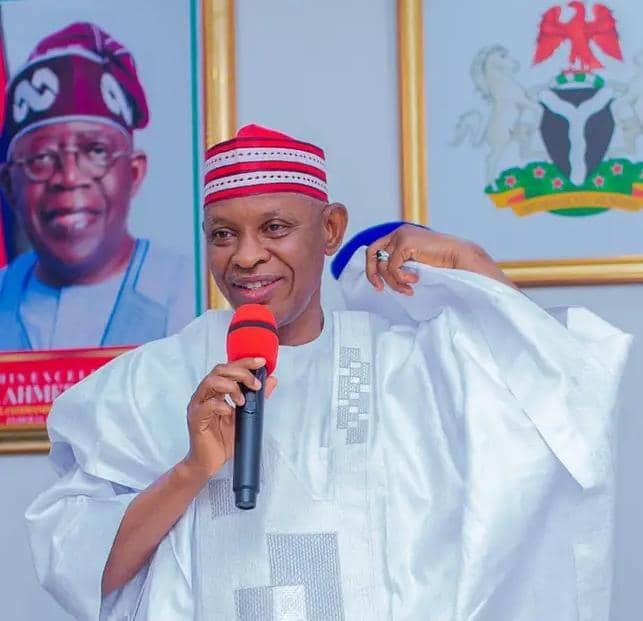

By Hon. Muhammad Sanusi Sa’id Kiru, FCIA
(Former Commissioner of Education, Kano State)
In the calculus of governance, timing is often the decisive factor between enduring impact and political obsolescence. The transition of Kano State Governor, Abba Kabir Yusuf, from the New Nigeria People’s Party (NNPP) to the All Progressives Congress (APC) serves as a definitive case study in political foresight. While critics occasionally mischaracterize such moves as mere opportunistic shifts, an analytical lens reveals a calculated strategy of institutional insulation and a commitment to long-term governance stability.
Governor Yusuf’s decision to sever ties with the NNPP and the political camp of Senator Rabiu Musa Kwankwaso stands as a masterclass in leadership. By distancing his administration from the internal dysfunction and structural decay that have come to define his former political home, the Governor has successfully insulated the machinery of Kano State governance from the tremors of the ongoing crisis currently consuming his former associates. While the opposition remains embroiled in reactive survivalism and fractured alliances, Governor Yusuf has secured a stable platform, ensuring that the critical business of public service remains uninterrupted.
The Nigerian political landscape is currently undergoing a painful structural correction. The legislative and judicial scrutiny now being applied to political parties—highlighted by ongoing legal challenges regarding the registration status of various entities—exposes the fragility of platforms that lack deep-rooted institutional viability. The current regulatory environment serves as a stark reminder that electoral legitimacy is not a static entitlement but a continuous requirement of statutory compliance. By preempting the inevitable turbulence of the opposition, Governor Yusuf has demonstrated an astute ability to read the electoral horizon.
Read Also:
Kwankwaso’s Son, Mustapha Emerges As NDC Deputy Governorship Candidate In Kano
The contrast is particularly sharp when observing the reactive trajectories of former opposition stalwarts. The recent, frantic migration of figures into unproven platforms suggests an approach driven more by necessity than by a coherent long-term strategy. While these figures attempt to navigate the uncertainties of a brand-new, unproven political environment, Governor Yusuf has firmly secured his position within a mainstream framework that is focused on continuity and the rigorous preparation required for the 2027 electoral cycle.
The Governor’s move demonstrates three pillars of modern political management. First, institutional anchoring: by aligning with a dominant national party, the Governor has secured a stable base for policy execution, minimizing the risk of administrative paralysis. Second, risk mitigation: the current legal and internal assault on smaller, underperforming parties creates a hazardous environment for any leader whose platform is not firmly grounded in compliance. Governor Yusuf’s transition acts as a robust insurance policy against the systemic risks currently threatening to dissolve the former structures he once navigated. Third, strategic positioning: leadership in a democracy requires the ability to anticipate the shifting tides of national politics before the storm arrives. By aligning with stability, Governor Yusuf has ensured that the interests of his constituents are not sidelined by the trial and error of emerging political experiments.
As the political class grapples with the fallout of registration crises and the frantic search for new electoral vehicles, the wisdom of the Governor’s decision becomes increasingly apparent. His transition was not a concession of principles, but a definitive pivot toward the sustainability of the state mandate. For the discerning analyst, the lesson is clear: in the high-stakes theater of Nigerian governance, the ability to align with stability is not merely a political maneuver; it is a fundamental prerequisite for effective and enduring leadership.
Hon. Muhammad Sanusi S. Kiru, FCIA is a former Commissioner of Education in Kano State and is writing from the comfort of his current location